


A philosophical and neurobiological look into the apian mind.
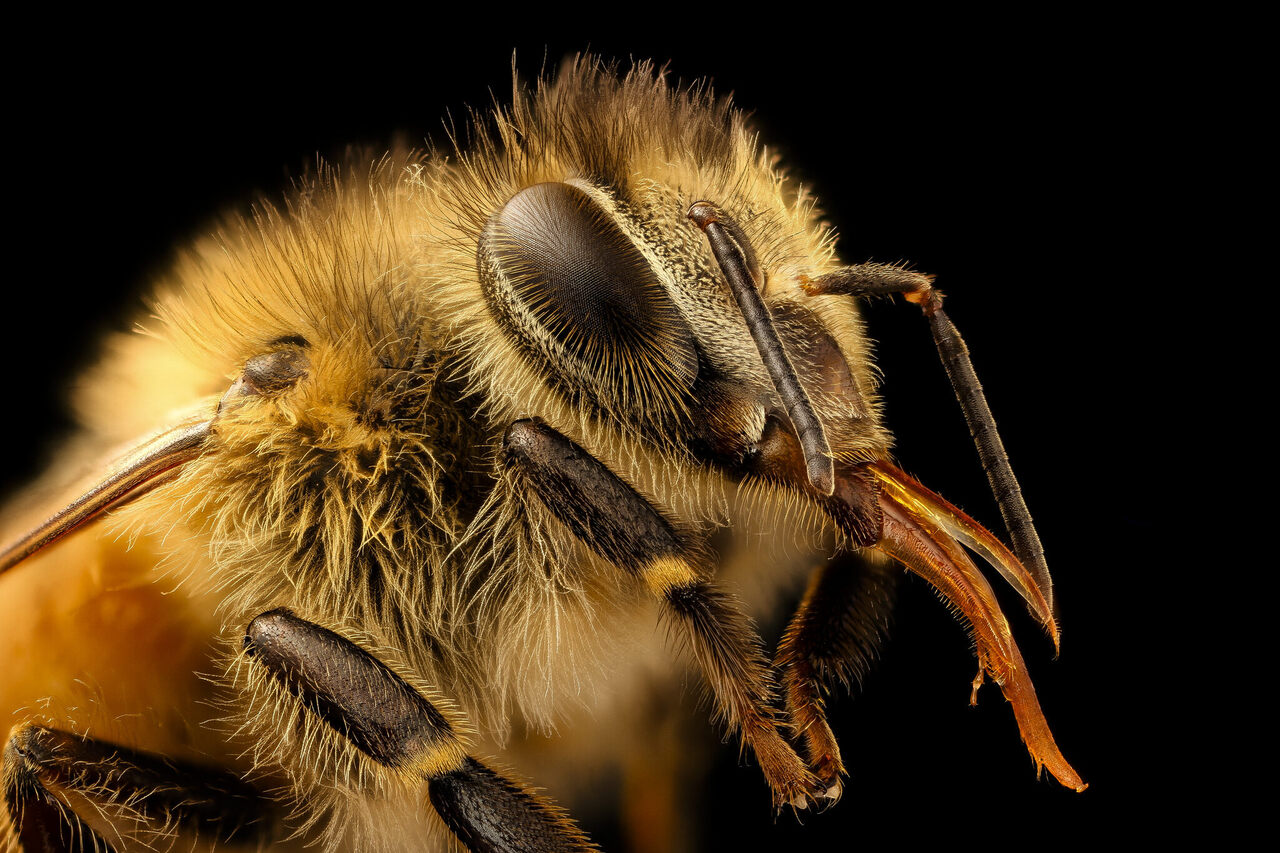
You’re a honeybee. Despite
being around 700,000 times smaller than the average human, you’ve got
more of almost everything. Instead of four articulated limbs, you have
six, each with six segments. (Your bee’s knees, sadly, don’t exist.)
You’re exceptionally hairy. A shock of bristly setae covers your body
and face to help you keep warm, collect pollen, and even detect
movement. Your straw-like tongue stretches far beyond the end of your
jaw, but has no taste buds on it. Instead, you “taste” with other,
specialized hairs, called sensillae, that you use to sense the chemicals
that brush against particular parts of your body.
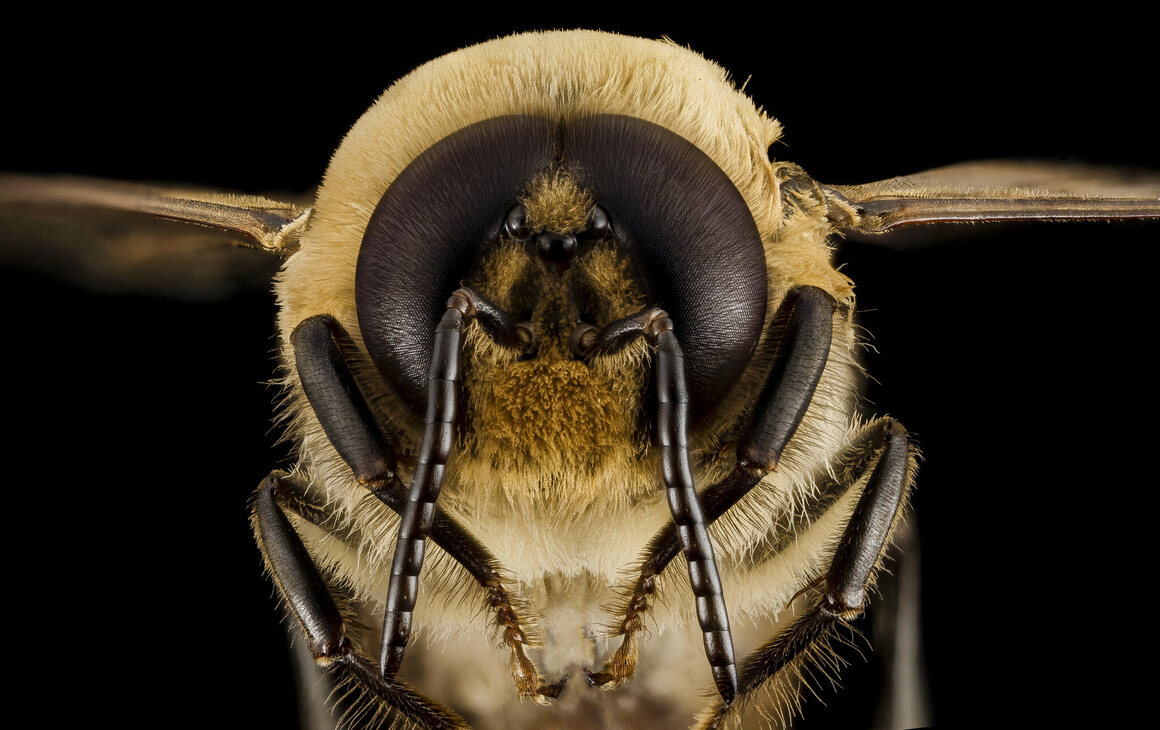
You’ve got five eyes. Two of them, called
compound eyes and made up of 6,900 tiny lenses, take up about half your
face. Each lens sends you a different “pixel,” which you use to see the
world around you. The colors you see are different.
Red looks like black to you and your three “primary” colors are blue,
green, and ultraviolet. You detect motion insanely well, but outlines
are fuzzy and images blocky, like a stained-glass window. (Your three
other eyes detect only changes in light to tell you quickly if something
dangerous is swooping your way.)
Now that you’re a honeybee you can do all
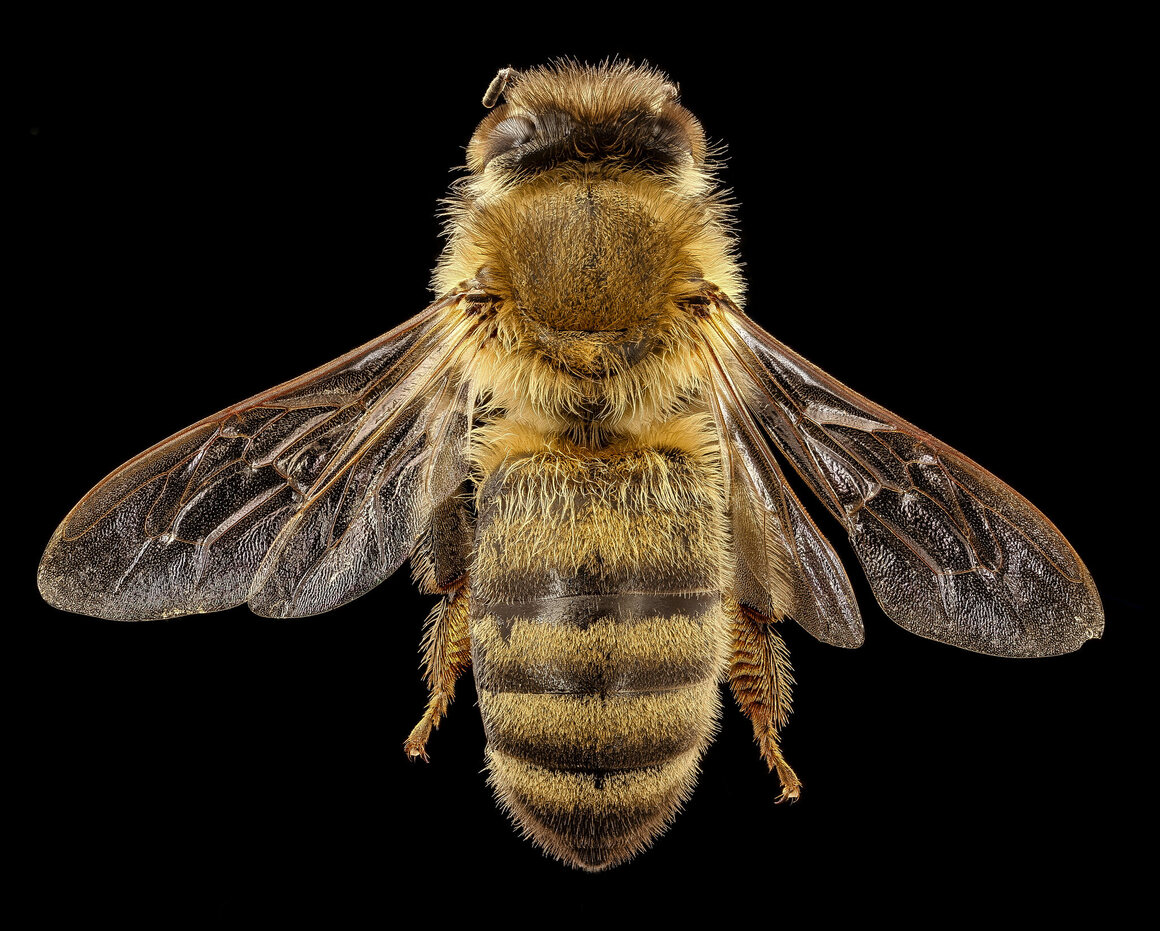
kinds of things you couldn’t before. Your four wings move at 11,400
strokes per minute. You can sense chemicals in the air. You’re fluent in
waggle dance,
so you’re able to tell the other members of your colony where the
nectar supplies are. But how much does any of this tell us about what it
actually feels like to be a bee?

We all know what it’s like
to be ourselves—to be conscious of the world around us, and be
conscious of that consciousness. But what consciousness means more
generally, for other people and other creatures, is a hot potato tossed
between philosophers, biologists, psychologists, and anyone who’s ever
wondered whether it feels the same to be a dog as it does to be an
octopus. In general, we think that if you have some kind of unique,
subjective experience of the world, you’re conscious to some extent. The
problem is that in trying to envisage any consciousness besides our
own, we run into the limits of the human imagination. In the case of
honeybees, it’s hard to know if interesting behavior is reflective of an
interesting experience of the world or masks a more simple
stimulus-response existence. The lights are on, but is anyone home? To
examine these questions means to take a ride on that hot potato—from
philosopher to scientist and back again and again and again.
More and more, scientific research seems
to suggest that bees do have a kind of consciousness, even as myths and
misconceptions about their capacities persist. In a recent TED Talk, cognitive scientist Andrew B. Barron
of Macquarie University in Sydney, Australia, described how he had had
to be lovingly “talked down” from a “pearl-clutching” moment after
someone asked him whether bees actually have brains. They do, of course.
Understanding what their consciousness
might look or feel like is probably a fool’s errand. It’s really hard to
imagine what it’s like to be almost anything or anyone other than what
you are, says philosopher Colin Klein,
also from Macquarie University, who has worked extensively alongside
Barron. With people, it’s much easier. “You can talk to them, you can
read fiction, there are a lot of things you can do—but it takes a
certain amount of work to get into that space and in particular to
realize what you experience, what you don’t experience, what your
horizons look like,” he says. But the more different the experience of
the organism you’re trying to imagine is, the harder it becomes. “You
can start to think at least in what senses the experience of something
like a bee might be different from ours”—how they structure the world
around them, say, or whether they experience “space” the way we do.
The philosopher Thomas Nagel’s famous 1974 essay, “What Is It Like to Be a Bat?”
suggests that being “like” something else is possible only if the
target is conscious of the world around it. “The fact that an organism
has conscious experience at all means, basically, that there is
something it is like to be that organism,” he writes. Or, “fundamentally
an organism has conscious mental states if and only if there is
something that it is to be that organism—something it is like for the
organism.” On top of that mindscrabble, our ability to imagine ourselves
as another being is limited by the world that we know—as people. We
might be able to imagine having webbed arms and hands, like a bat, or
five eyes, like a bee, but the specific senses and abilities these
animals possess are frankly inconceivable. “I want to know what it is
like for a bat to be a bat. Yet if I try to imagine this, I am
restricted to the resources of my own mind, and those resources are
inadequate to the task,” he adds.
Moreover, “I cannot perform it either by imagining additions to my
present experience, or by imagining segments gradually subtracted from
it.”
Despite these difficulties, what we want to know, Klein and Barron wrote in an op-ed in The Conversation in 2016, is whether bees and other insects “can feel and sense the environment from a first-person perspective.”

It seems likely that there are
lots of different kinds of consciousness, of varying levels of
complexity. As human beings, not only are we aware of ourselves and the
world around us, we’re also aware of that awareness. A step down in
complexity might lack that awareness of self-awareness. And a step down
from that might be limited to a distinctive experience of the external
world only.
Such a simple ladder may not be the best way to organize this kind of complexity, says David Chalmers, a leather jacket-wearing Australian philosopher
at New York University best known for his work in philosophy of mind—a
branch of philosophy that asks these kinds of questions. “But there are
probably different ways of arranging states of mind, or consciousness,
in a hierarchy,” he says. What’s harder to distinguish is the precise
point where consciousness ends, and what the light switch, “on-off,”
moment might be, further down the evolutionary chain. “It’s awfully hard
to see what a borderline case of being conscious would be,” he says,
even while it’s not that hard to know what a borderline case of being
alive might look like, as in a virus. “It would sort of feel like
something,” he says, trailing off in thought, “but not.”
So far as bee consciousness goes,
however, he thinks there are likely to be some factors in consciousness
that we share, like vision, and some that we don’t at all, “whether it’s
sensory systems that humans have that bees don’t have, or whether it’s
things more like concepts, like language, that give us a kind of
consciousness that bees don’t have.”
Klein is more specific. “We think that
bees have experiences that feel like something to the bee,” he says. “We
don’t think the bees are aware of having experiences that feel like
something to them. The bee is not going round saying to itself, ‘Gee,
it’s a lovely day, look at that flower.’ It doesn’t have any of these
more sophisticated, reflexive kinds of consciousness.”
Still, despite having a brain that
is a fraction of the size of even the tiniest mammal’s, bees seem
capable of some incredibly complex behaviors and mental gymnastics.
Studies over the last few decades have revealed them to do everything
from having a concept of zero to experiencing emotion, from tool use to social learning. If you give them cocaine, they dance more vigorously and tend to overestimate how much pollen they’ve foraged. If they watch a plastic bee scoring goals with a soccer ball,
they can follow suit for a sugar water reward. Wouldn’t these complex
behaviors be enough to assume some kind of consciousness? Not
necessarily, says Barron. “Honeybees are unusual among the insects in
that they have a whole list of clever things that they are able to do,”
he says. “And some people would say that that means that they are more
likely to be conscious. I disagree with that.”
Think of all the other things able to
perform complicated tasks that we’re pretty sure aren’t conscious.
Robots do everything from juggle to play the piano,
but, as far as we know, are “dark” inside. Like bees, Roomba vacuum
cleaners make decisions, navigate around the world, and adapt—but
there’s probably nothing it’s “like” to be one of them. And plants have been shown
to have a kind of memory: Over time, for example, they can learn that
being repeatedly dropped isn’t anything to freak out about. But few
suggest they possess consciousness.
“I think this is one of the problems with
the behavioral approach, is that it encourages this looking for very
clever things,” says Klein. “Whereas if consciousness is a widespread
phenomenon, you should expect that it might be in a lot of different
types of things that don’t necessarily do the things that we take to be
markers of consciousness.”
If behavior can’t enough tell us about
the inner life of a bee, perhaps the structure of their sesame
seed–sized brains can. In a human brain, key studies suggest consciousness lies in the midbrain, an evolutionarily much older section. In a study published last year,
Barron and Klein investigated the structure of the bee brain, which
seems to be made up of similar bits to our own, with a region
responsible for similar tasks. “It’s smaller, it’s organized
differently, it’s different-shaped, but if you look at the kind of
computations it does, it’s doing the same sort of things as the
midbrain,” Klein says. “So if you think in humans the midbrain is
responsible for being conscious, and you think this is doing the same
kind of thing, then you ought to think insects are conscious as well.”

This biological approach opens up
consciousness to a variety of other organisms that don’t do the clever
things that bees do, like beetles or potato bugs. They might be less
obviously interesting, but that doesn’t make them less likely to be
conscious. The technology that allows us to examine insect brains on a
neuron-by-neuron level is very new, Barron says. “If they really are
instinctive, then we’re learning something about what the insect brain
is capable of. If they’re not, then we’re learning something more
profound.”
The technology also allows us to map the
brains of organisms that we think probably aren’t conscious, and assess
what they lack. Caenorhabditis elegans is a roundworm commonly used in scientific research. In recent years, scientists have developed a connectome—a
sort of complex brain map—for this tiny soil-dweller, which measures
barely a millimeter in length. “They have 302 neurons,” says Klein,
compared to a bee’s 960,000 and a human’s 86 billion. “Those [worms], we
think, are actually very much like robots, like complicated robots.” If
exposed to a particular stimulus, they respond in a particular,
predictable way. “Unless there’s some kind of danger, and then it does
that, unless it’s hungry, and then it does this—so you can really map
out what it’s going to do.” In bees, he says, there seems to be a kind
of qualitative shift, in which the brain is somehow more than its
connections.
All of this neurobiology is beginning to paint a picture—that it feels like nothing to be a C. elegans,
or a robot, or a plant, but it probably feels like something to be a
bee. If that’s the case, it is still not known where, between the
roundworm and the honeybee, that awareness switches on, if it does.
While neurobiology is a very important part of the story, says Chalmers,
“it may not settle the issue of consciousness. You very frequently find
a situation where two people might agree on the neurobiology of a given
case, but disagree on what that implies about consciousness.” He gives
the example of fish, and the ongoing discourse about whether their
neurobiology suggests that they do or do not feel pain. “Knowing the
neurobiological facts doesn’t necessarily settle the question.”
We can try to imagine what
it’s like to be have six hairy legs, or see in pixels, or crave nectar.
We can even try to imagine what it’s like to be part of a hive, a
superorganism with motivations of its own. But what it’s actually like
to be a bee—its subjective experience of the world—is going to remain
elusive. But we’re starting to figure out that it’s probably like
something. And that’s not nothing.

Đăng nhận xét