Purpose of the articles posted in the blog is to share knowledge and occurring events for ecology and biodiversity conservation and protection whereas biology will be human’s security. Remember, these are meant to be conversation starters, not mere broadcasts :) so I kindly request and would vastly prefer that you share your comments and thoughts on the blog-version of this Focus on Arts and Ecology (all its past + present + future).
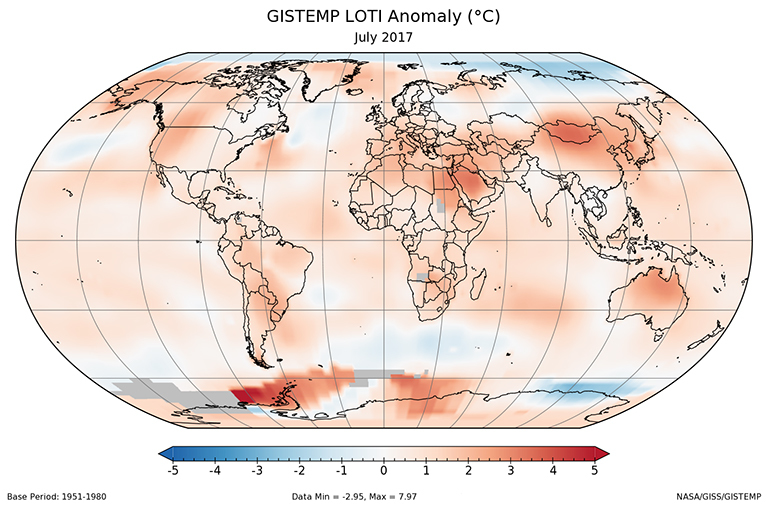
A global map of the June 2017 LOTI (land-ocean temperature index) anomaly, relative to the 1951-1980 June average. View larger image.
July 2017 was statistically tied with July 2016 as the warmest July
in the 137 years of modern record-keeping, according to a monthly
analysis of global temperatures by scientists at NASA's Goddard
Institute for Space Studies (GISS) in New York.
Last month was about 0.83 degrees Celsius warmer than the mean July
temperature of the 1951-1980 period. Only July 2016 showed a similarly
high temperature (0.82 °C), all previous months of July were more than a
tenth of a degree cooler.
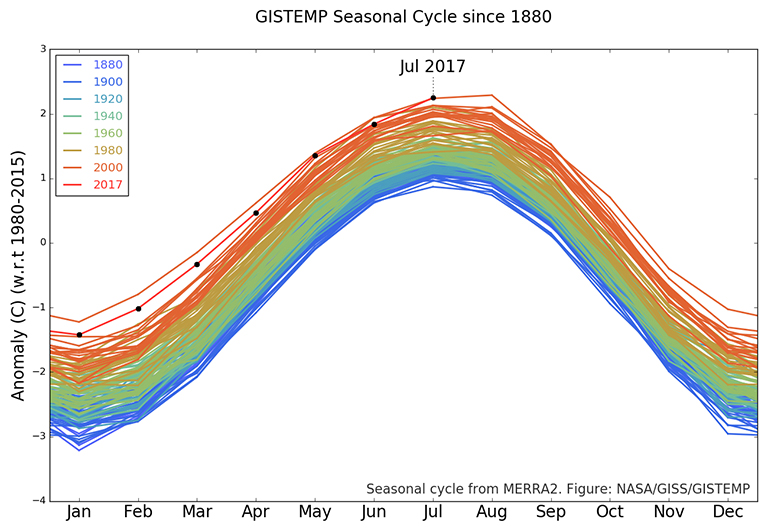
The GISTEMP monthly temperature anomalies superimposed on a 1980-2015 mean seasonal cycle. View larger image or PDF.
Starting with this update, the previously used ocean data set ERSST
v4 was replaced by the newer ERSST v5. This contributed to the changes
of some of the data in last month's update. For more information, see
the Updates to Analysis and the History Pages.
The monthly analysis by the GISS team is assembled from publicly
available data acquired by about 6,300 meteorological stations around
the world, ship- and buoy-based instruments measuring sea surface
temperature, and Antarctic research stations.
The modern global temperature record begins around 1880 because
previous observations didn't cover enough of the planet. Monthly
analyses are sometimes updated when additional data becomes available,
and the results are subject to change.



Đăng nhận xét